Understanding number systems is one of the most important foundational skills in AP® Computer Science A—and one of the most confusing for students at first.
If you’ve ever looked at binary, hexadecimal, or octal numbers and thought, “Where do I even start?”—you’re not alone.
When I teach this topic, I see the same pattern every year:
- Students understand decimal (base 10) easily
- Then binary and hex show up… and everything feels harder
But once you understand the patterns, it actually becomes one of the most logical and rewarding topics in computer science.
In this post, I’ll break down how base conversions work, why they matter for AP CSA, and how you can practice effectively using a structured resource.
Why Number Systems Matter in AP Computer Science A
In programming, computers don’t “think” in base 10.
They use:
- Binary (base 2) → the language of computers
- Hexadecimal (base 16) → used for memory and color codes
- Octal (base 8) → sometimes used in systems and permissions
Understanding these systems helps students:
- Write more efficient code
- Understand how data is stored
- Solve AP exam questions with confidence
👉 This is not just test prep—it’s real computer science thinking.
Quick Overview of Number Systems
Before converting, students need a clear foundation.
Decimal (Base 10)
- Digits: 0–9
- What we use every day
Binary (Base 2)
- Digits: 0, 1
- Each place value = powers of 2
Example:
1011 = 8 + 0 + 2 + 1 = 11
Octal (Base 8)
- Digits: 0–7
- Groups binary into sets of 3
Hexadecimal (Base 16)
- Digits: 0–9 and A–F
- A = 10, B = 11 … F = 15
- Groups binary into sets of 4
How to Convert Between Number Systems (Step-by-Step)
This is where students usually struggle—so clarity matters.
Binary → Decimal
- Write out powers of 2
- Multiply each digit
- Add the results
Example:
1101 = 8 + 4 + 0 + 1 = 13
Decimal → Binary
- Divide by 2 repeatedly
- Track remainders
- Read from bottom to top
Binary → Hexadecimal
- Group digits in 4s
- Convert each group
Example:
1010 = A
1111 = F
Binary → Octal
- Group digits in 3s
- Convert each group
💡 These patterns are MUCH easier when students can see them visually—which is why structured practice is so important.
Common Mistakes Students Make
From teaching this every year, here are the biggest struggles:
- Forgetting place values
- Mixing up grouping (3 vs 4 digits)
- Not practicing enough conversions
- Memorizing instead of understanding
👉 The solution is guided repetition + visual support
A Resource That Actually Helps Students Master This
To help students move from confusion → confidence, I created a structured resource:
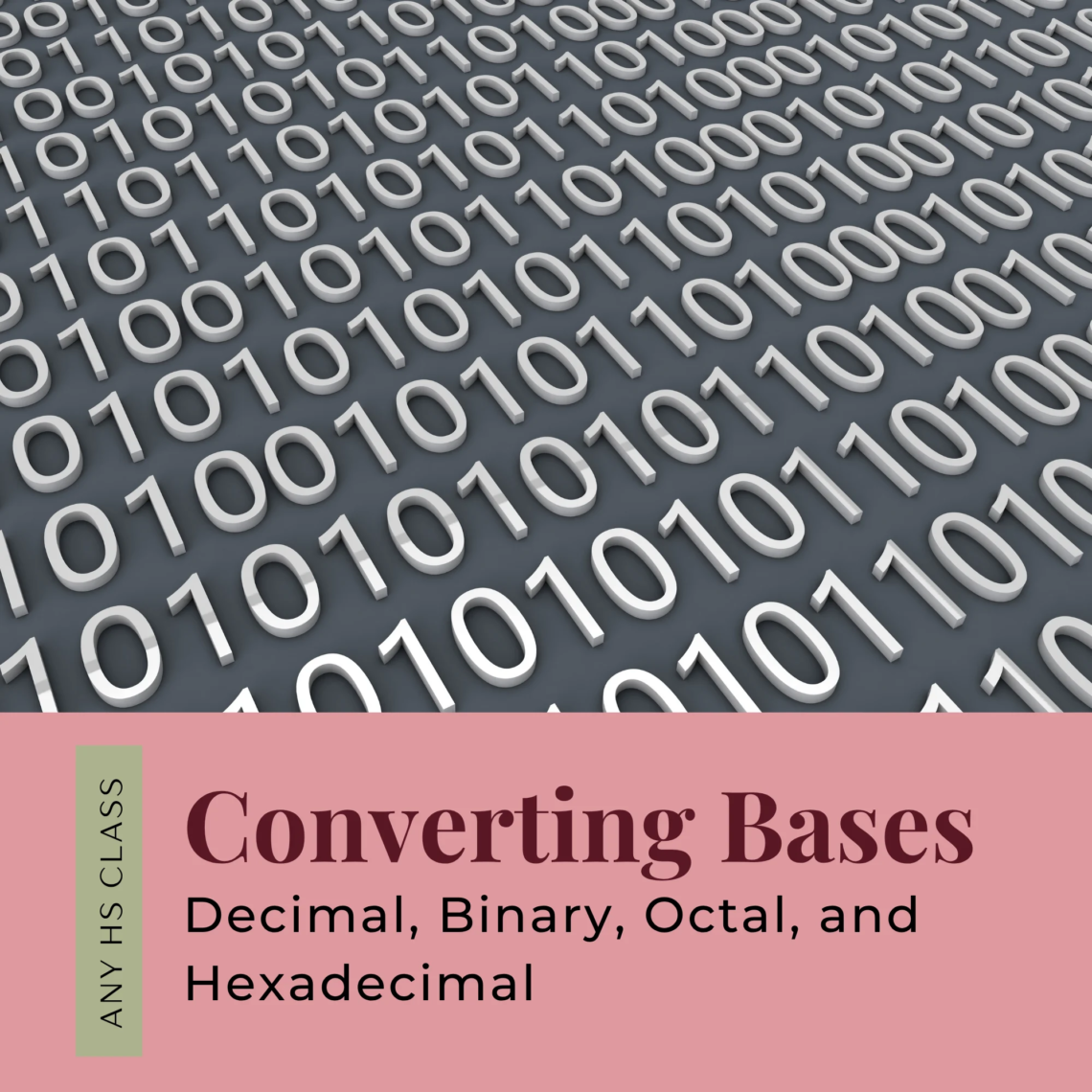
👉 Converting Binary, Decimal, Octal, & Hexadecimal Bases – Handout & Worksheet
This isn’t just a worksheet—it’s a complete learning system.
📘 What’s Included
- Clear conversion charts
- Step-by-step instructions
- Scaffolded practice problems
- Answer key for self-checking
🎯 Why This Works
Students don’t just “see” the process—they practice it in a way that builds understanding over time.
They:
- Start with guided examples
- Move into independent practice
- Check their work immediately
👉 That’s how mastery actually happens
How to Use This in the Classroom (or at Home)
Here’s what works best:
1. Teach → Then Practice Immediately
Don’t wait.
- Show one example
- Let students try
2. Use Collaborative Learning
Have students:
- Work in pairs
- Explain steps out loud
👉 Teaching others = deeper understanding
3. Apply to Real Coding Scenarios
Ask questions like:
- “Why does binary matter in memory?”
- “Where do we see hex in real life?”
If you’re looking for another engaging activity for students, you might also like
👉 AP Computer Science A: Drawing Landscapes with Java’s Print & Println, which helps students apply programming concepts creatively.
Building Confidence for the AP Exam
Number systems show up regularly on the AP CSA exam.
Students who practice this well will:
- Solve questions faster
- Avoid simple mistakes
- Feel more confident overall
👉 Confidence comes from practice + understanding
Connecting This to Bigger Learning Skills
This topic also builds:
- Logical thinking
- Pattern recognition
- Problem-solving skills
These are skills students will use far beyond the test.
Final Thoughts: From Confusion to Confidence
Binary, octal, and hexadecimal might feel overwhelming at first—but they don’t have to stay that way.
With the right approach:
- Clear explanations
- Structured practice
- Repetition with purpose
Students can move from:
👉 “I don’t get this”
to
👉 “This actually makes sense”
Get the Full Resource
If you want a ready-to-use tool that walks students through this step-by-step:
👉 Converting Binary, Decimal, Octal, & Hexadecimal Bases – Handout & Worksheet
Perfect for:
- AP Computer Science A classes
- Independent learners
- Review and reinforcement
Let’s Connect
Do your students struggle more with:
- Binary conversions
- Hexadecimal
- Or just knowing where to start?
Drop a comment—I’d love to hear what’s working (or not working) in your classroom.