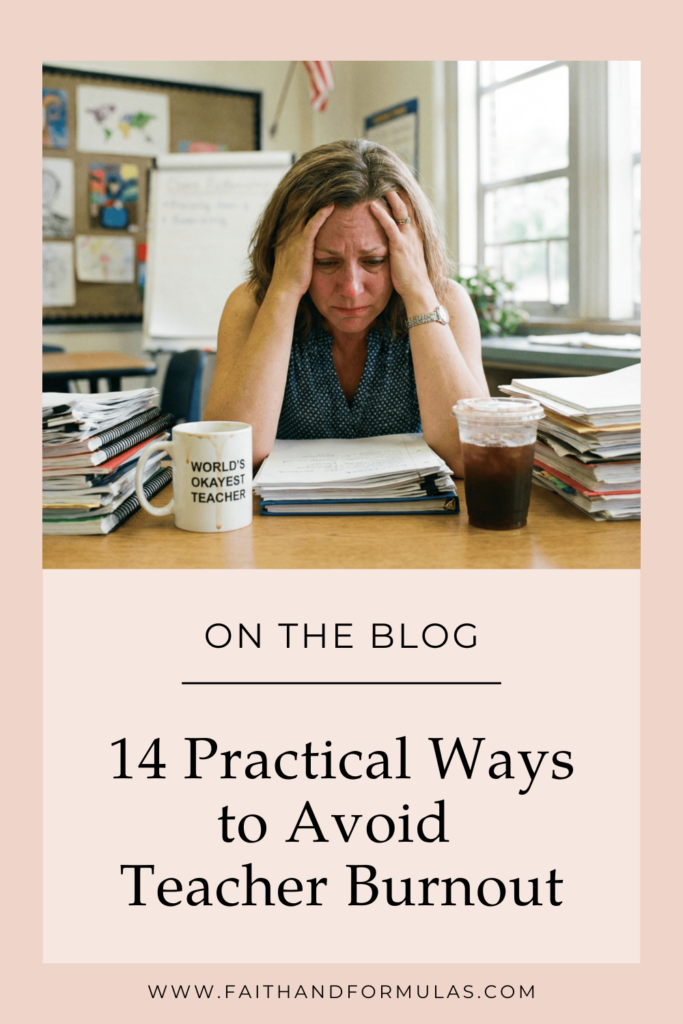
If you’ve been in education for more than a few years, you’ve probably felt it creeping in.
The exhaustion that sleep doesn’t fix.
The shorter patience.
The loss of creativity.
The quiet thought: I can’t keep running like this.
I’ve written before about the symptoms of teacher burnout — the emotional numbness, the constant fatigue, the creeping self-doubt. But what I’ve learned is this: burnout rarely shows up overnight. It builds slowly, layer by layer, when we keep pouring out without intentionally refilling.
Avoiding teacher burnout isn’t about caring less.
It’s about caring wisely.
And if I’m honest, I’ve had to learn that the hard way.
Here’s what I’m doing differently now — not perfectly, but intentionally — to avoid slipping back into burnout.
1. I Stopped Trying to Be Everything for Everyone
Teaching naturally attracts helpers.
We want to support struggling students.
We want to answer every parent email thoughtfully.
We want to differentiate perfectly.
We want to stay late for tutoring.
We want to sponsor the club.
We want to serve.
But somewhere along the way, I realized I was trying to be the solution to every problem in my classroom.
And that’s not sustainable.
I am responsible for being faithful and prepared.
I am not responsible for controlling every outcome.
That shift freed me.
Students still struggle sometimes.
Parents still have concerns.
Lessons still fall flat occasionally.
But I no longer carry every variable as a personal burden.
Avoiding burnout means recognizing your limits — and respecting them.
2. I Set Boundaries Around My Time
This one was uncomfortable at first.
Teaching expands to fill whatever space you give it.
There will always be:
- Another paper to grade
- Another lesson to refine
- Another email to answer
- Another strategy to try
For a long time, I let teaching spill into evenings without hesitation.
Now, I ask:
“Is this necessary tonight?”
Sometimes the answer is yes.
Often, it’s no.
I set a time to stop working.
I don’t check email late at night.
I allow some tasks to wait until morning.
The work will still be there tomorrow.
My mental clarity might not be — if I don’t protect it.
3. I Lowered the Pressure of Perfection
Perfectionism fuels burnout.
In math and computer science especially, I used to feel pressure to:
- Anticipate every student misconception
- Create flawless notes
- Design the most engaging activity possible
- Grade everything thoroughly and immediately
But perfect lessons don’t prevent hard days.
Now, I aim for effective — not flawless.
Sometimes a solid, straightforward lesson is enough.
Sometimes “good and clear” is better than “creative and exhausting.”
Perfection drains. Excellence sustains.
4. I Protect My Energy in the Classroom
Teaching requires constant emotional output.
You’re regulating tone.
Managing behavior.
Explaining content.
Encouraging participation.
Monitoring understanding.
That’s a lot.
I’ve learned to protect my energy by:
- Not escalating small things unnecessarily
- Using proximity instead of volume
- Choosing calm over confrontation
- Pausing instead of reacting
When I manage my own emotions first, I leave the day less drained.
Emotional discipline reduces emotional exhaustion.
5. I Accept That Some Days Will Just Be Average
Not every lesson will be transformative.
Not every class period will feel inspiring.
And that’s okay.
There was a season when I measured my effectiveness by daily engagement levels. If students seemed quiet or distracted, I internalized it.
Now I remind myself:
Consistency matters more than daily intensity.
Avoiding burnout means allowing space for ordinary days.
You don’t have to be extraordinary every hour to be impactful over time.
6. I Focus on Long-Term Growth, Not Immediate Results
Burnout often comes from feeling like your effort isn’t producing visible fruit.
But teaching is long-term work.
Some seeds grow slowly.
In math and computer science, I may not see confidence bloom immediately. But months later, a student who once doubted themselves solves a problem independently.
Avoiding burnout means zooming out.
Instead of asking, “Did this lesson go perfectly?”
I ask, “Am I moving them forward over time?”
Progress accumulates quietly.
7. I Limit Comparison
It’s easy to compare.
Other teachers seem:
- More creative
- More energetic
- More organized
- More innovative
Social media especially amplifies polished highlights.
But comparison drains joy.
My classroom does not need to look like someone else’s to be effective.
Avoiding burnout means staying focused on the students in front of me — not the imaginary audience in my head.
8. I Say No When I Need To
This was hard.
I don’t like disappointing people.
But overcommitment is one of the fastest paths to burnout.
Before agreeing to something new, I now ask:
“Do I realistically have margin for this?”
If the answer is no, I decline kindly.
Saying no to one thing allows me to say yes well to what matters most.
9. I Build Systems That Reduce Decision Fatigue
Burnout often isn’t about one big stressor. It’s about thousands of small decisions.
So I simplified where I could.
- Clear classroom procedures
- Consistent grading policies
- Structured routines
- Templates for parent communication
Systems reduce mental load.
And reduced mental load preserves energy.
10. I Prioritize Real Rest
Rest is not scrolling.
Rest is not grading on the couch.
Rest is true mental disengagement.
I’ve had to relearn how to:
- Take a walk without thinking about school
- Read something unrelated to teaching
- Spend time with family fully present
- Worship without planning next week’s lesson in my head
Rest is not laziness.
It’s refueling.
And without it, burnout returns quickly.
11. I Pay Attention to Early Warning Signs
Now that I’ve experienced burnout before, I recognize the early signals:
- Irritation rising faster
- Creativity decreasing
- Dreading certain classes
- Emotional flatness
When I notice those signs, I adjust sooner.
I lighten where I can.
I ask for support.
I reevaluate expectations.
Avoiding burnout isn’t about never getting tired.
It’s about responding before exhaustion becomes identity.
12. I Remember That My Identity Is Not My Profession
This one has been deeply important for me.
I love teaching.
But I am not only a teacher.
When my entire identity centered on classroom performance, every hard day felt personal.
Separating identity from profession brought freedom.
I can care deeply without tying my worth to student outcomes.
For me, grounding my identity in my faith has been stabilizing. It reminds me that my value isn’t determined by engagement data, test scores, or lesson success.
That perspective protects my heart.
13. I Pray for Sustainability, Not Just Success
There was a time when my prayers about teaching sounded like:
“Help this lesson go well.”
“Help students stay engaged.”
Now they sound more like:
“Help me be steady.”
“Help me last.”
“Help me teach from overflow, not depletion.”
Sustainability matters more than momentary success.
Avoiding burnout is about endurance.
14. I Accept That Education Is a Marathon
Teaching is not a sprint.
It’s not even a single school year.
It’s a career built on consistency.
Some seasons will be heavier.
Some classes will be more challenging.
Some years will stretch you more than others.
Avoiding burnout means pacing yourself for the long run.
You don’t have to solve every issue this semester.
You don’t have to transform every student immediately.
You don’t have to prove your dedication through exhaustion.
Faithfulness over frenzy.
Steadiness over spectacle.
Final Thoughts
How do you avoid teacher burnout?
Not by caring less.
Not by disengaging.
Not by becoming cynical.
You avoid burnout by:
- Setting boundaries
- Releasing perfection
- Protecting your energy
- Building systems
- Prioritizing rest
- Staying rooted in purpose
- Monitoring your own capacity
Burnout happens when output exceeds input for too long.
So refill intentionally.
You are allowed to teach passionately and still protect your peace.
Let’s Learn From Each Other
What has helped you avoid teacher burnout?
What boundaries have made a difference?
What habits protect your energy?
What did you have to learn the hard way?
Share in the comments below. Your experience might help another teacher build sustainability before exhaustion sets in.
We don’t have to burn out to prove we care.
And we don’t have to navigate this alone.