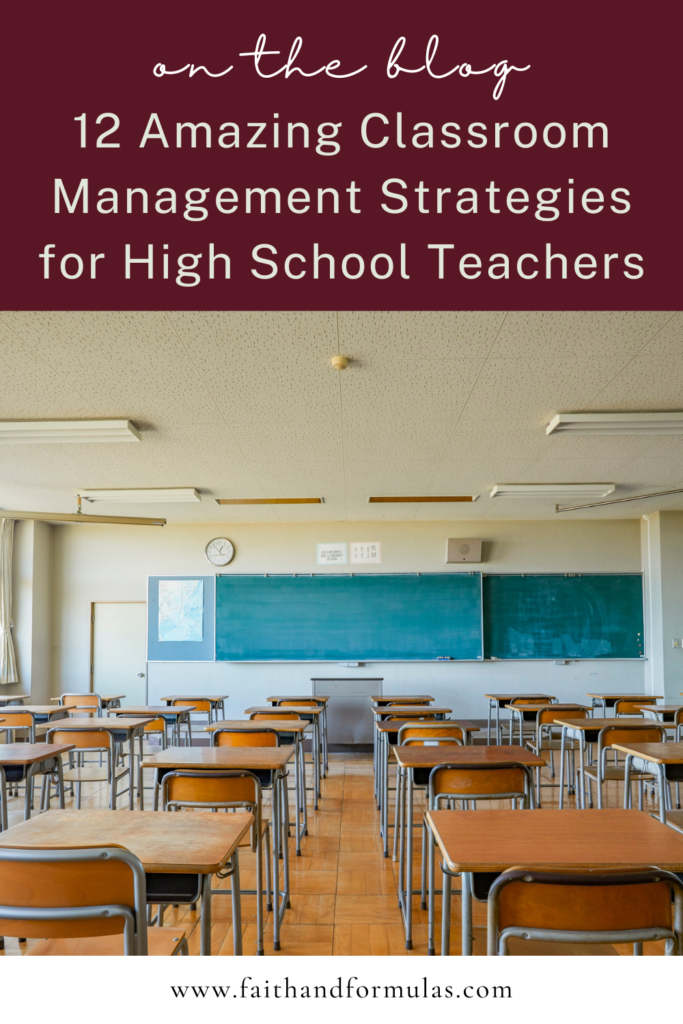
Let me say this first: classroom management in high school is not about being the loudest, strictest, or most intimidating person in the room.
If it were, I would have figured it out much faster.
When I first started teaching, I thought classroom management meant having the perfect seating chart, a detailed discipline ladder, and a voice that could command silence on demand. I quickly learned that high school students don’t respond long-term to volume or authority alone. They respond to consistency. They respond to authenticity. And most of all, they respond to relationships.
Over the years — through trial, error, exhaustion, reflection, and growth — I’ve developed classroom management strategies that actually work. Not because they’re flashy. Not because they’re trendy. But because they’re rooted in understanding teenagers as whole people.
If you’re struggling, overwhelmed, or just looking to refine your approach, here’s what has made the biggest difference in my classroom.
1. Start With Relationships Before You Start With Rules
Yes, you need rules. Yes, you need procedures. But if relationships don’t come first, your rules will feel like control instead of structure.
At the beginning of every semester, I make it a priority to get to know my students before behavior ever becomes an issue. I ask about their interests. I notice their talents. I learn how they participate. I greet them at the door. I use their names — quickly and correctly.
When students feel seen early, they are far less likely to escalate later.
And when they do mess up (because they will), the conversation shifts. Instead of, “She’s just picking on me,” it becomes, “I let down someone who actually cares.”
Relationship-building doesn’t eliminate misbehavior. But it creates a foundation where correction doesn’t feel like an attack.
2. Be Clear About Expectations — and Teach Them Explicitly
One mistake I made early on was assuming high school students “should already know” how to behave.
They don’t.
Or at least, not in the way you expect.
I’ve learned to explicitly teach:
- What respectful discussion looks like
- What independent work time should sound like
- How group work should function
- How transitions should happen
We practice it. We model it. We reset it after breaks.
Clarity prevents conflict. Students push boundaries less when they clearly understand them.
And when expectations are violated, I can calmly say, “That doesn’t align with what we agreed on,” instead of reacting emotionally.
3. Consistency Is More Important Than Severity
High school students can handle consequences. What they struggle with is unpredictability.
If one student gets three warnings and another gets written up immediately for the same behavior, they notice. And once fairness is questioned, respect erodes quickly.
I’ve learned that I don’t need harsh consequences — I need consistent ones.
Predictability creates safety.
Students may not love the consequence, but they respect knowing where the line is and that it doesn’t move based on my mood.
4. Address Behavior Privately Whenever Possible
Public correction often turns into public performance.
If a student is disruptive, I take them into the hallway. Removing the audience changes everything. Without peers watching, defensiveness lowers. Conversations become real.
In those one-on-one moments, I’ve heard things I never would have heard in front of the class:
- “I didn’t understand the assignment.”
- “I’m just really tired.”
- “Stuff is bad at home right now.”
- “I didn’t mean to take it that far.”
Even when students don’t open up, the private conversation de-escalates the situation and preserves dignity.
High schoolers care deeply about how they look in front of their peers. Give them space to save face.
5. Separate the Student From the Behavior
This one changed my classroom.
Instead of saying, “You’re being disrespectful,” I say, “That behavior isn’t respectful.”
It seems small, but it matters.
Teenagers are still forming their identities. When correction feels like a character attack, they defend themselves. When correction targets behavior, they’re more likely to adjust it.
I remind myself often: this is a kid making a poor choice, not a bad kid.
6. Use Proximity Before You Use Volume
Sometimes the most powerful classroom management strategy is simply walking closer.
Standing near a chatty group.
Making eye contact.
Pausing mid-sentence and waiting.
I’ve learned that I don’t have to stop instruction every time there’s a minor disruption. Often, proximity and presence are enough.
And when you don’t escalate every small thing, students don’t feel constantly targeted.
7. Give Choices Instead of Ultimatums
High school students crave autonomy. The more you try to control every move, the more they resist.
Instead of saying:
“You need to stop right now.”
I say:
“You can refocus and stay with us, or you can step out for a minute and reset.”
Choice gives ownership.
And ownership leads to better decisions.
When students feel like they have agency, behavior improves dramatically.
8. Contact Home Early — Not Just When It’s Bad
This strategy has saved me more times than I can count.
Reaching out to parents before writing a referral shifts the dynamic. It communicates partnership instead of punishment.
Even more powerful? Positive contact home early in the year.
When parents have already heard something good from you, they are far more receptive when something needs correction.
It also sends a clear message to students: the adults in your life are connected.
9. Remember That Regulation Comes Before Instruction
You cannot teach a dysregulated brain.
If a student is angry, embarrassed, anxious, or overwhelmed, no amount of content will land.
Sometimes classroom management means pausing the lesson.
Letting a student take a break.
Having a quick reset conversation.
Offering a moment to breathe.
I’ve learned that five minutes spent regulating emotions can save fifty minutes of chaos.
10. Pray for Your Students Outside the Classroom
This is deeply personal, but it has shaped how I manage my classroom more than any strategy on paper.
There are students whose behavior lingers with you after the day ends. Instead of replaying frustration, I’ve learned to pray for them.
Not as a replacement for boundaries.
Not as avoidance of consequences.
But as a shift in posture.
When I pray for a student, my heart softens. My perspective widens. I remember that I see them for fifty minutes a day — and they are living an entire life outside my classroom.
Prayer changes me. And when I walk back into the room with compassion instead of irritation, the atmosphere shifts.
Sometimes the student changes. Sometimes I change first.
11. Don’t Take It Personally (Even When It Feels Personal)
This is one of the hardest lessons.
Teenagers test boundaries. They project frustration. They misdirect emotion.
Most of the time, their behavior is not about you.
When I stopped internalizing every eye roll and sarcastic comment, I became calmer. And calm teachers manage classrooms better.
Responding instead of reacting has become one of my greatest classroom management tools.
12. Focus on Long-Term Growth, Not Daily Perfection
There will be hard days.
There will be classes that drain you.
Moments you wish you handled differently.
Students who push every boundary.
But classroom management is not about winning every interaction. It’s about long-term growth.
Sometimes the student who challenges you the most is the one who needed consistency, patience, and care the most.
And sometimes the seeds you plant won’t show up until years later.
Final Thoughts: It’s About Steadiness, Not Control
Classroom management strategies for high school teachers aren’t about power. They’re about steadiness.
Be steady in your expectations.
Steady in your consequences.
Steady in your tone.
Steady in your care.
High school students live in a world that feels chaotic. When your classroom feels predictable, relational, and fair, they settle into it.
Not perfectly.
Not instantly.
But meaningfully.
And if you’re in a season where classroom management feels overwhelming, know this: you are not failing. You are learning. Every experienced teacher has walked through this refining process.
Let’s Learn From Each Other
Classroom management is not one-size-fits-all. What works beautifully in one classroom may not translate to another.
I’d love to hear from you.
What classroom management strategies have worked in your high school classroom?
What didn’t work?
What did you have to learn the hard way?
Share in the comments below. Your insight might be exactly what another teacher needs to read today.
We’re better when we learn from each other — and when we remember we’re not doing this work alone.